
Selecting the right titanium fasteners requires a deep understanding of various factors that impact performance and longevity. From material grade to environmental resistance, each element plays a crucial role in determining the fastener’s suitability for specific applications. In this article, we’ll explore these key considerations, helping to ensure the best choice for demanding projects.

Strength and Weight of Titanium
High Strength Benefits
Titanium shows impressive high strength compared to many metals. Engineers choose titanium fasteners for projects that demand durability and reliability. High strength allows these fasteners to withstand heavy loads and resist deformation.
- High strength in titanium fasteners supports structures in aerospace, automotive, and marine industries.
- These fasteners maintain their shape under stress, which reduces the risk of failure.
- High strength also means fewer replacements, saving time and resources.
Lightweight Advantages
Titanium offers a unique combination of high strength and low weight. This metal weighs much less than steel but provides similar or greater strength. Titanium fasteners help reduce the overall weight of assemblies.
- Lightweight titanium fasteners improve fuel efficiency in vehicles and aircraft.
- Lower weight makes installation easier and reduces strain on supporting structures.
- Titanium’s lightweight nature also benefits sports equipment and medical devices.
A table below compares titanium to other common metals:
| Material | Density (g/cm³) | Relative Strength | Weight Advantage |
|---|---|---|---|
| Titanium | 4.5 | High | Excellent |
| Steel | 7.8 | High | Poor |
| Aluminum | 2.7 | Moderate | Good |
Titanium fasteners combine high strength with lightweight properties. This combination makes them valuable in many industries.
Corrosion Resistance for Improved Durability
Moisture and Chemical Exposure
Titanium stands out for its ability to resist corrosion in wet and chemical-rich environments. The metal forms a thin oxide layer on its surface. This layer protects the material from rust and chemical attack.
Many industries use titanium in places where water or chemicals are present. For example, chemical processing plants rely on titanium to handle acids and chlorides. Marine engineers choose titanium for ship parts that face saltwater every day.
Harsh Environment Suitability
Titanium performs well in extreme conditions. High temperatures, saltwater, and industrial chemicals do not easily damage this metal. This makes titanium fasteners a top choice for corrosion-resistant applications.
Aerospace engineers use titanium in jet engines and airframes. These parts face both heat and moisture. Oil and gas companies also use titanium for pipelines and offshore rigs.
- Titanium resists pitting and crevice corrosion.
- The metal keeps its strength and shape in harsh environments.
- Fasteners made from titanium require less maintenance and fewer replacements.
A comparison table shows how titanium handles tough environments:
| Environment | Steel | Aluminum | Titanium |
|---|---|---|---|
| Saltwater | Poor | Moderate | Excellent |
| Acidic Chemicals | Poor | Poor | Excellent |
| High Temperatures | Moderate | Poor | Excellent |
Titanium fasteners help extend the life of equipment. They reduce the risk of failure in challenging settings.
Titanium Grades
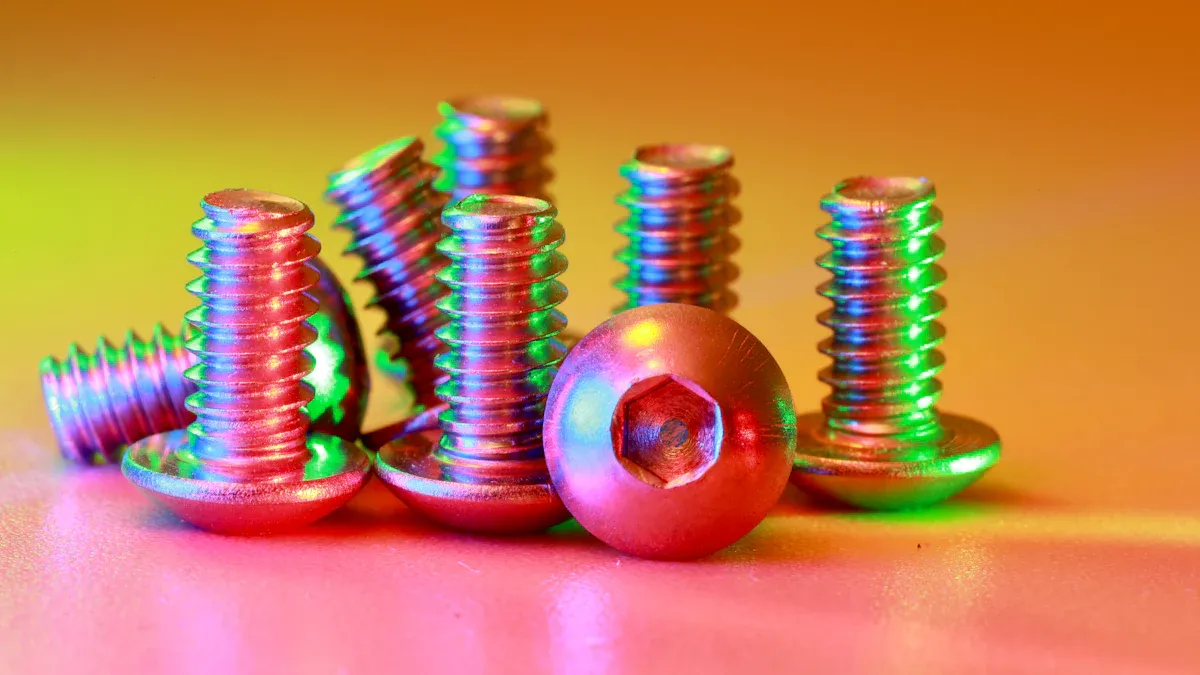
Choosing the right grade of titanium helps ensure the best performance for titanium fasteners. Grade selection affects how well fasteners handle stress, corrosion, and chemicals. The three most common grades are gr2, gr5, and gr7.
Grade 2: Corrosion Resistance
Gr2 stands out for its excellent resistance to corrosion. Many industries use gr2 when they need fasteners that can handle moisture and mild chemicals. Gr2 works well in marine environments, chemical processing, and medical devices.
Gr2 has moderate strength but offers high ductility. This means gr2 can bend without breaking. Gr2 also resists saltwater and many acids.
Grade 5: High Strength
Gr5 provides much higher strength than gr2. Engineers choose gr5 for applications that require fasteners to hold heavy loads. Gr5 contains aluminum and vanadium, which increase its strength.
Gr5 works well in aerospace, automotive, and industrial machinery. Gr5 can handle high temperatures and stress. Gr5 also keeps its shape under pressure.
A table compares gr2 and gr5:
| Property | gr2 | gr5 |
|---|---|---|
| Strength | Moderate | High |
| Ductility | High | Moderate |
| Corrosion Resistance | High | Good |
Gr5 fasteners support critical structures where safety matters most.
Grade 7: Extreme Chemical Resistance
Gr7 offers the best resistance to extreme chemicals. Gr7 contains palladium, which helps protect against strong acids and harsh environments. Gr7 is ideal for fasteners used in chemical plants and power generation.
Gr7 resists corrosion better than gr2 and gr5 in aggressive settings. Gr7 also maintains its properties in both hot and cold conditions. Gr7 fasteners last longer in places where other metals fail.
Selecting the right grade—gr2, gr5, or gr7—makes a big difference in how titanium fasteners perform. Grade selection should match the needs of the application for the best results.
Compatibility with Other Materials
Material Interaction
Engineers must consider how titanium interacts with other materials in an assembly. Titanium has a unique surface that resists many types of chemical reactions. When titanium comes into contact with metals like steel or aluminum, it usually does not cause unwanted reactions.
Some materials can cause problems if they touch titanium for long periods. For example, copper and brass may lead to surface changes on titanium. Careful selection of companion materials helps prevent unexpected issues.
Galvanic Corrosion Risks
Galvanic corrosion happens when two different metals touch in the presence of moisture. Titanium resists corrosion, but it can still act as a cathode in a galvanic cell. If titanium connects to a less noble metal, the other metal may corrode faster.
A table below shows the risk of galvanic corrosion with common metals:
| Metal Paired with Titanium | Galvanic Corrosion Risk |
|---|---|
| Stainless Steel | Low |
| Aluminum | Moderate |
| Copper | High |
Designers should use insulating washers or coatings to separate titanium from metals with high corrosion risk. This practice extends the life of both the titanium fasteners and the connected parts. Regular inspections help catch early signs of corrosion.
Standards and Certifications
Industry Standards
Industry standards help ensure that titanium fasteners meet safety and quality requirements. Many industries use standards from organizations like ASTM and ISO. These standards set rules for the size, strength, and chemical makeup of titanium.
A table below shows common standards for titanium:
| Standard | Description | Application Area |
|---|---|---|
| ASTM B348 | Titanium Bars and Billets | Aerospace, Medical |
| ISO 898 | Mechanical Properties | General Engineering |
| ASTM F468 | Nonferrous Bolts | Chemical Processing |
Engineers check these standards before choosing fasteners. Meeting standards helps prevent failures and ensures long service life.
Certification Needs
Certifications prove that titanium meets industry standards. Suppliers provide certificates that show test results and material grades. These documents help buyers trust the quality of the fasteners.
Some projects require extra testing. For example, aerospace and medical fields often need detailed reports. Certification helps keep people safe and equipment reliable.
Cost and Sourcing for Optimal Value

Budget Factors
Cost plays a major role when selecting titanium fasteners. Titanium often costs more than other metals because of its extraction and processing methods. Buyers must balance the benefits of titanium with their project budget.
Some projects require only a few fasteners, while others need thousands. Large orders may qualify for discounts, but small batches can cost more per piece. Engineers should compare the long-term savings from durability and low maintenance against the initial price.
CNC machining helps control quality and reduce waste. This process creates precise titanium parts, which lowers the risk of defects. Reliable machining also means fewer replacements and less downtime.
Availability and Lead Times
Availability affects how quickly a project can move forward. Titanium is not as common as steel or aluminum, so lead times may be longer. Some suppliers keep standard sizes in stock, but custom fasteners may require extra time.
Engineers should check supplier inventories before placing orders. Planning ahead helps avoid delays, especially for large or specialized projects. Fast delivery ensures that construction or repairs stay on schedule.
A table below shows typical lead times for different materials:
| Material | Standard Lead Time | Custom Lead Time |
|---|---|---|
| Steel | 1-2 weeks | 3-4 weeks |
| Aluminum | 1-2 weeks | 3-5 weeks |
| Titanium | 2-4 weeks | 4-8 weeks |
Choosing titanium fasteners requires careful attention to application, grade, mechanical properties, and compatibility. Use a checklist to compare gr2, gr5, and gr7 titanium bolts and nuts for each project. Review supplier certifications and seek expert advice to ensure the best titanium bolts and nuts, including gr2, gr5, and gr7 titanium bolts and nuts, meet your needs.
- gr2 titanium bolts and nuts offer corrosion resistance.
- gr5 titanium bolts and nuts provide high strength.
- gr7 titanium bolts and nuts deliver extreme chemical resistance.
- Titanium fasteners, including gr2, gr5, and gr7 titanium bolts and nuts, support reliable assemblies.
Conclusion
In conclusion, selecting the right titanium fasteners is essential for ensuring the strength, durability, and longevity of critical applications across industries. Factors such as material grade, corrosion resistance, and compatibility with other materials directly impact the performance and reliability of the fasteners. By understanding these key considerations, engineers can make informed decisions that optimize both cost-effectiveness and safety. Ultimately, titanium fasteners provide a high-value solution for demanding environments, where performance and resilience are paramount.


