
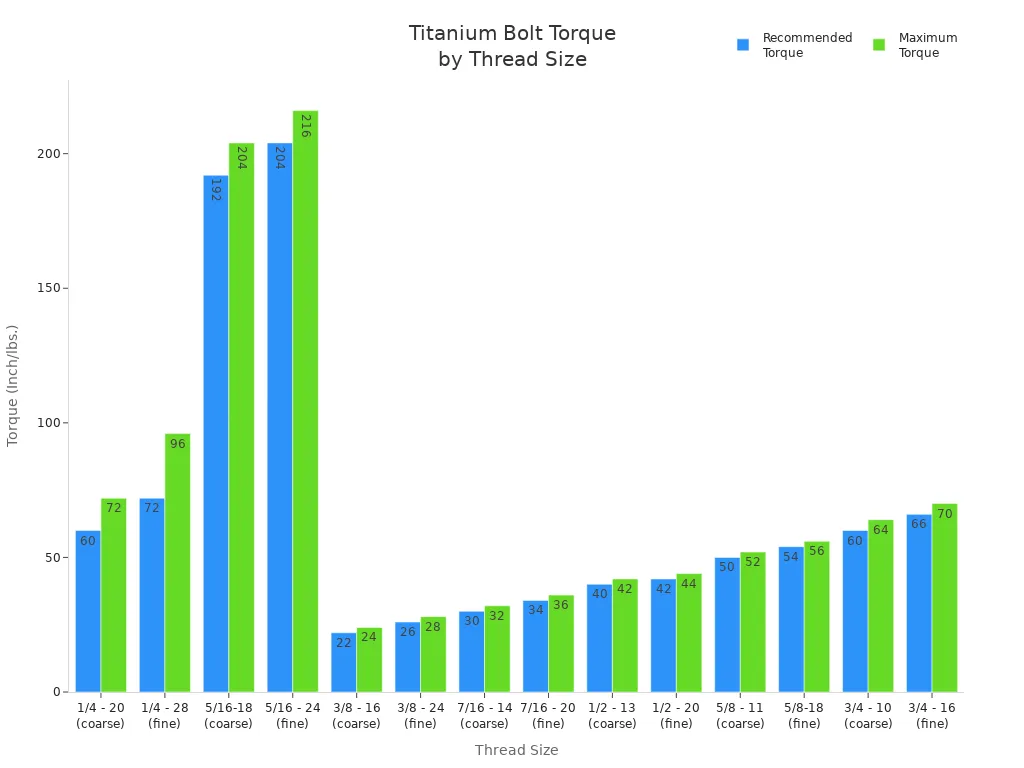
Titanium bolt preload ensures the joint remains secure under load and prevents loosening. Industry standards recommend using 70%-80% of the bolt’s proof load for optimal performance. The table below displays suggested torque values for common titanium bolt sizes:
| Thread Size | Recommended Torque (Inch/lbs.) | Maximum Torque (Inch/lbs.) |
|---|---|---|
| 1/4 – 20 (coarse) | 60 | 72 |
| 1/4 – 28 (fine) | 72 | 96 |
| 5/16-18 (coarse) | 192 | 204 |
| 5/16 – 24 (fine) | 204 | 216 |
| 3/8 – 16 (coarse) | 22 | 24 |
| 3/8 – 24 (fine) | 26 | 28 |
| 7/16 – 14 (coarse) | 30 | 32 |
| 7/16 – 20 (fine) | 34 | 36 |
| 1/2 – 13 (coarse) | 40 | 42 |
| 1/2 – 20 (fine) | 42 | 44 |
| 5/8 – 11 (coarse) | 50 | 52 |
| 5/8-18 (fine) | 54 | 56 |
| 3/4 – 10 (coarse) | 60 | 64 |
| 3/4 – 16 (fine) | 66 | 70 |
Preload Basics For Titanium Bolts
What Is Preload
Preload describes the initial tension applied to a titanium bolt during tightening. This tension creates a clamping force that holds the joint together and resists external loads. Engineers measure preload using the formula: Preload (F) = 0.75 × A × σy, where F is the preload force, A is the tensile stress area, and σy is the yield strength of the bolt material.
A properly applied preload ensures that the bolt remains under tension, even when subjected to dynamic forces. This tension helps prevent joint separation and maintains the structural integrity of the assembly. Titanium bolts rely on consistent preload to deliver reliable performance in demanding environments.
Preload also influences how the joint responds to vibration and shifting loads. When the correct tension is present, the bolt resists loosening and maintains a secure connection. This process protects the joint from unexpected movement and reduces the risk of failure.
Why Preload Matters
Preload plays a critical role in the safety and durability of titanium bolt assemblies. It maintains joint integrity by preventing movement between connected parts, which is essential in applications exposed to vibration or shifting loads. Even load distribution across the joint minimizes the risk of failure from localized stress concentrations.
Adequate preload increases fatigue resistance, allowing the joint to withstand repeated loading cycles without cracking or breaking. Engineers depend on proper tension to extend the lifespan of assemblies and reduce maintenance needs. In sealing applications, preload maintains compression and prevents leaks, which is vital for systems transporting fluids or gases.
Without sufficient preload, bolts may loosen, leading to compromised safety and performance. Excessive tension can also damage the bolt or joint, so precise preload application is necessary. Professionals use torque charts and calculation methods to achieve the ideal balance between tension and fatigue resistance.
Titanium Bolt Preload Calculation
Torque and Preload Relationship
Titanium bolt preload depends on the torque applied during installation. Engineers use torque application to create tension in the bolt, which generates the desired preload. The relationship between torque and preload is linear, so doubling the torque doubles the tension, as long as the bolt does not yield.
The following table summarizes the key variables in this relationship:
| Variable | Description |
|---|---|
| T | Torque applied to the bolt |
| F | Resulting preload in the bolt |
| D | Diameter of the bolt |
| K | Nut factor (torque coefficient) |
Preload torque must be calculated carefully to avoid exceeding the bolt’s proof load. Most engineering standards recommend a preload of 70%-80% of the proof strength for titanium bolts. This range balances tension and fatigue resistance, ensuring the joint remains secure under load.
- A preload of about 80% of the proof strength is commonly used.
- Bolts are often preloaded to 75% of proof load for proper joint functioning.
Engineers use digital torquemeters and statistical analysis to measure and verify preload torque. These tools help ensure that the connector screw preload meets design requirements and maintains joint integrity.
Factors Affecting Preload
Several factors influence the preload achieved in titanium bolts. Surface finish and thread condition play a significant role. When tightening a nut, microscopic high points on the threads create friction. These points can shear and lock together, increasing friction and reducing effective preload.
Thread size also affects preload. If the thread is too large, it may fit too tightly, resulting in lower preload for the same torque. If the thread is too small, the contact area decreases, which can cause screw teeth to fail under load. High contact pressure and friction during tightening generate heat at the thread interface. This heat can cause local adhesion, leading to thread seizure and negatively impacting preload.
Engineers use several methods to determine correct preload and torque:
| Method/Tool | Description |
|---|---|
| Digital Torquemeter | Measures fixation and removal torques, calibrated to industry standards. |
| Statistical Analysis | Analyzes preload and torque values using ANOVA methods. |
| Preload Measurement | Obtains values after stabilization, averaging multiple measurements. |
| Finite Element Analysis | Evaluates preloading through screw elongation, suggesting optimal levels. |
Preload relaxation can occur over time due to material settling or environmental changes. Engineers must account for this effect to maintain proper tension and fatigue resistance throughout the life of the assembly. Proper preload application ensures that titanium bolt preload remains consistent, minimizing the risk of joint failure.
Titanium Bolt Preload Chart
Recommended Values
Engineers rely on titanium bolt preload charts to select the correct tightening torque for each bolt size. These charts provide recommended preload and tightening torque values that help maintain joint tension and prevent fatigue. The values in the chart below represent typical recommendations for common titanium bolt sizes under standard conditions.
| Thread Size | Recommended Preload (lbf) | Recommended Tightening Torque (in-lbs) | Maximum Tightening Torque (in-lbs) |
|---|---|---|---|
| 1/4 – 20 | 1,800 | 60 | 72 |
| 1/4 – 28 | 2,160 | 72 | 96 |
| 5/16 – 18 | 3,600 | 192 | 204 |
| 5/16 – 24 | 4,080 | 204 | 216 |
| 3/8 – 16 | 5,400 | 222 | 244 |
| 3/8 – 24 | 6,000 | 266 | 288 |
| 7/16 – 14 | 7,800 | 300 | 320 |
| 7/16 – 20 | 8,400 | 340 | 360 |
| 1/2 – 13 | 10,800 | 400 | 420 |
| 1/2 – 20 | 11,400 | 420 | 440 |
| 5/8 – 11 | 15,000 | 500 | 520 |
| 5/8 – 18 | 16,200 | 540 | 560 |
| 3/4 – 10 | 21,600 | 600 | 640 |
| 3/4 – 16 | 23,400 | 660 | 700 |
Note: The recommended preload and tightening torque values may change based on application and environment. Factors such as friction coefficients, lubrication, temperature, and material type can influence the preload achieved for a given torque.
| Factor | Description |
|---|---|
| Friction Coefficients | Vary between materials, affecting torque-preloading relationship. |
| Lubrication Conditions | Influence the friction and thus the preload values. |
| Temperature Variations | Can alter material properties and friction coefficients, impacting preload. |
| Material Type | Titanium screws have higher friction coefficients than steel, necessitating adjustments in torque. |
How to Use the Chart
Engineers interpret titanium bolt preload charts by matching the bolt size to the recommended preload and tightening torque. They must consider the relationship between applied torque and bolt preload, which follows the formula T = K · db · Fp. The nut factor (K) changes with different materials and lubricants, so accurate preload application requires careful selection of these variables.
- Engineers should verify that the preload is sufficient for the joint’s function.
- They must analyze bolt loads to prevent failure in tension or shear.
- The desired bolt stretch depends on the required preload for the fastener.
- Working loads and potential failure modes must be considered before finalizing the tightening torque.
- For bolts with a grip-to-diameter ratio below 4:1, engineers should calculate expected stretch or determine the preload-stretch relationship experimentally.
Standard preload charts offer guidance for typical applications. In non-standard situations, these charts may not account for embedding loss, axial and shear forces, or variations in tightening methods. Environmental influences such as thermal expansion can also affect titanium bolt preload. Engineers should adjust recommended preload values and tightening torque to suit specific conditions, ensuring the joint maintains proper tension and resists fatigue.


Tailored Titanium Bolts to Achieve Ideal Preload
Why Customization Are Needed
Engineers often require titanium bolts designed for specific preload requirements. Custom titanium fasteners enhance performance and extend lifespan in demanding environments. They reduce the risk of part failure in mission-critical operations by meeting exact tolerances.
Custom bolts last under harsh conditions without rusting or degrading, which leads to fewer replacements and lower maintenance costs. Enhanced mechanical properties allow bolts to handle unique load-bearing or vibration-dampening needs. Titanium bolts offer a superior strength-to-weight ratio, making them ideal for applications where weight reduction is crucial.
High corrosion resistance ensures reliability in harsh environments, minimizing maintenance needs. Outstanding durability allows these bolts to withstand constant tension and extreme temperatures. Customization helps maintain connector screw preload and prevents fatigue failures.
Tip: Custom titanium bolts provide reliable tension and fatigue resistance, especially in aerospace, marine, and motorsport applications.
How to Customize Titanium Bolts
Manufacturers offer several customization options to optimize titanium bolt preload and tension. Engineers select head designs, sizes, and finishes to match specific project requirements. The table below summarizes common customization choices:
| Customization Option | Description |
|---|---|
| Color Options | Titanium bolts can be anodized in various colors for aesthetic appeal. |
| Head Design Variations | Options include hexagonal, Torx, and anti-theft designs, impacting both aesthetics and functionality. |
| Size and Fitment Considerations | Available in various sizes to ensure proper fitment for different vehicles and assemblies. |
Engineers choose bolt sizes that match the required tension and preload for each application. They select head designs that improve torque application and resist fatigue under repeated loading. Anodized finishes protect against corrosion and help maintain tension over time.
Customization allows engineers to address preload relaxation and maintain connector screw preload in specialized environments. By tailoring titanium bolts, they achieve optimal tension and minimize fatigue, ensuring long-term reliability.
Common Mistakes to Avoid
Over-Tightening
Over-tightening titanium bolts remains a frequent error in industrial settings. When installers exceed the recommended preload, they risk thread stripping, bolt deformation, or even fracture. Excessive tension can deteriorate the bolt’s strength over time, leading to creep and eventual joint failure.
- Over-tightening can cause screw fracture and compromise the assembly’s integrity.
- High tension increases the risk of fatigue, especially in environments with repeated loading cycles.
- Using a torque wrench helps prevent this mistake by ensuring precise tension application.
Tip: Always follow torque specifications to avoid damaging the bolt or joint.
Under-Tightening
Under-tightening poses significant risks to joint reliability. Insufficient preload leaves connections vulnerable to vibration, noise, and reduced performance. Loose bolts may separate under stress, causing structural failure or safety hazards.
- Inadequate tension can result in fatigue and premature loosening.
- Mechanical assemblies with low preload often experience joint separation and vibration-induced failures.
- Product recalls and reputational damage may occur if under-tightening leads to widespread failures.
Installers should always verify that the applied tension meets the recommended preload for each bolt size.
Ignoring Environmental Factors
Environmental conditions play a crucial role in preload retention and fatigue resistance. Temperature fluctuations can weaken titanium bolts and reduce their ability to maintain tension. Corrosive environments, such as those with chlorides, may accelerate preload loss if not properly managed.
- Titanium bolts resist many corrosive agents, but ignoring surface preparation or using incompatible materials can still cause problems.
- High temperatures compromise bolt strength and tension, increasing the risk of fatigue and joint failure.
- Neglecting these factors can lead to poor preload retention and costly maintenance issues.
Note: Always consider environmental influences when selecting and installing titanium bolts to ensure long-term tension and fatigue resistance.
Conclusion
Titanium bolt assemblies demand precise preload and correct technique to ensure safety and reliability.
- Preload creates clamping force, prevents loosening, and distributes tension evenly across the joint.
- Engineers achieve optimal tension by following recommended percentages and using calibrated tools.
- Proper tension improves fatigue life and maintains structural integrity in rigorous applications.
- Sufficient preload allows bolts to resist fatigue and maintain tension under dynamic loads.
- Consulting torque charts and best practices helps engineers avoid fatigue failures and tension loss.
Bolt preload remains essential for the survival of joints, effective load distribution, and enhanced fatigue resistance. Engineers should always verify tension and fatigue performance for every application.


